

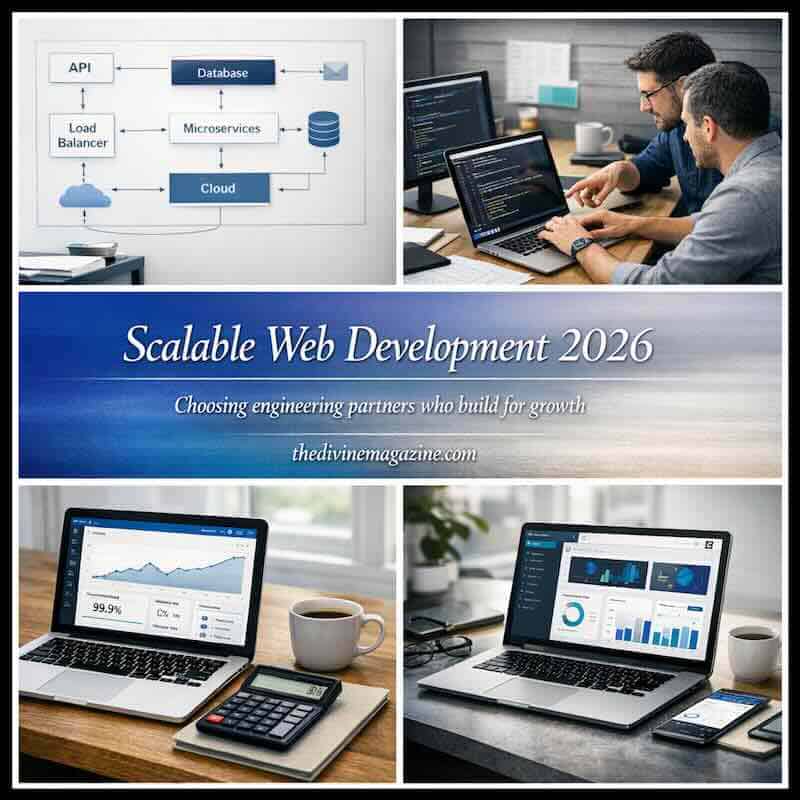
When comparing web application development services, the real question is not who can build a product fastest. It is who can build it in a way that still works when usage grows, features expand, and the business model changes. That is where the difference between a short-term vendor and a long-term engineering partner becomes clear. Teams like Codebridge matter because scalable products depend on architecture, not only delivery speed.
- Start with Product Scalability, Not Just Feature Delivery
- Evaluate Web App Architecture Before You Evaluate Price
- Check Whether Performance Is a Built-In Requirement
- Security Should Be Part of the Delivery Model
- Look for Product Thinking, Not Order-Taking
- Questions to Ask Before Choosing a Web App Development Company
- Conclusion
Many companies choose a development partner based on price, design samples, or a rough feature estimate. That is usually a mistake. A scalable product needs the right technical foundation, clear delivery discipline, strong performance standards, and security built into the process from the start. Google continues to emphasize crawlability, content quality, and page experience, while cloud architecture guidance from AWS and Microsoft consistently frames scalability around reliability, performance, and operational resilience.
Start with Product Scalability, Not Just Feature Delivery
A good web app development company should ask how your product will grow before discussing frameworks. That includes expected traffic, user roles, integrations, admin complexity, reporting needs, and future expansion into mobile, AI features, or multi-region support.
Scalable web application development is about more than handling traffic spikes. It also means supporting change without rebuilding the product every six months. Microsoft’s architecture guidance notes that modern web apps must be secure, flexible, and able to handle demand spikes, while AWS frames scalable systems around reliability, performance efficiency, and cost-aware design.
A strong partner should help you define:
- which features belong in the MVP
- what must be built for scale now
- what can be postponed safely
- where technical shortcuts will create future risk
Evaluate Web App Architecture Before You Evaluate Price
The biggest hidden cost in custom web application development is weak architecture. A low initial quote can become expensive when the system is hard to extend, slow under load, or fragile during releases.
More Read

Ask potential providers how they approach:
- backend modularity
- database design
- API structure
- authentication and access control
- third-party integrations
- caching and performance optimization
- deployment pipelines and rollback strategy
This matters because scalable products need room for iteration. AWS and Azure both position architecture decisions as central to long-term reliability and operational quality, not just infrastructure setup.
Why Architecture Quality Decides Long-Term Cost
A partner that thinks beyond code will separate business logic from presentation, avoid unnecessary complexity early, and design for future extensibility. That does not mean overengineering. It means making choices that reduce rework later.
In practice, that includes:
- clear service boundaries
- predictable data flows
- observability and error tracking
- infrastructure that can scale without major rewrites
Check Whether Performance Is a Built-In Requirement
If performance is treated as a polish step at the end, the product will suffer. Google explicitly recommends good Core Web Vitals and strong page experience because loading performance, interactivity, and visual stability affect real user experience.
That makes performance a business issue, not just a technical one. Slow products convert worse, rank worse, and create support overhead.
Ask whether the team plans for:
- fast page load on mobile
- efficient frontend rendering
- image and asset optimization
- database query performance
- caching strategy
- performance testing before launch
Security Should Be Part of the Delivery Model
If a provider speaks about scalability without speaking about security, that is a red flag. Growth increases exposure. More users, more integrations, and more admin operations create more risk.
OWASP’s ASVS exists specifically to verify web application security controls, and the OWASP Top 10 remains a reference standard for critical web application risks.
A serious web application development services partner should have a process for:
- secure authentication and session management
- role-based permissions
- input validation
- dependency review
- environment separation
- release checks before deployment
Look for Product Thinking, Not Order-Taking
The best web application development services do not just implement tickets. They challenge assumptions, identify delivery risk, and help shape the product roadmap. That is especially important for founders and product teams that need to balance time-to-market with long-term scalability.
A strong partner should be able to explain:
- what to build first
- what to simplify
- what should remain configurable
- what may break at scale
- what metrics should be tracked after launch
That kind of thinking reduces waste and improves decision quality.
Questions to Ask Before Choosing a Web App Development Company
Use these questions during evaluation:
- How do you design products for future scaling?
- What does your architecture planning process look like?
- How do you handle performance testing?
- What security standards or checklists do you follow?
- How do you manage releases, rollbacks, and monitoring?
- Can you show examples of products you helped scale over time?
The goal is not to hear buzzwords. The goal is to understand whether the team can build a stable product business, not just a working demo.
Conclusion
Choosing web application development services for a scalable product is really a decision about architecture, delivery maturity, and long-term product economics. The right partner will think beyond the first release. They will help you build a system that performs well, stays secure, adapts to growth, and remains maintainable as the product evolves.
If you evaluate providers only by quote or speed, you risk paying for the same product twice. If you evaluate them by architecture, performance, security, and product judgment, you improve your odds of building something that can actually scale.