
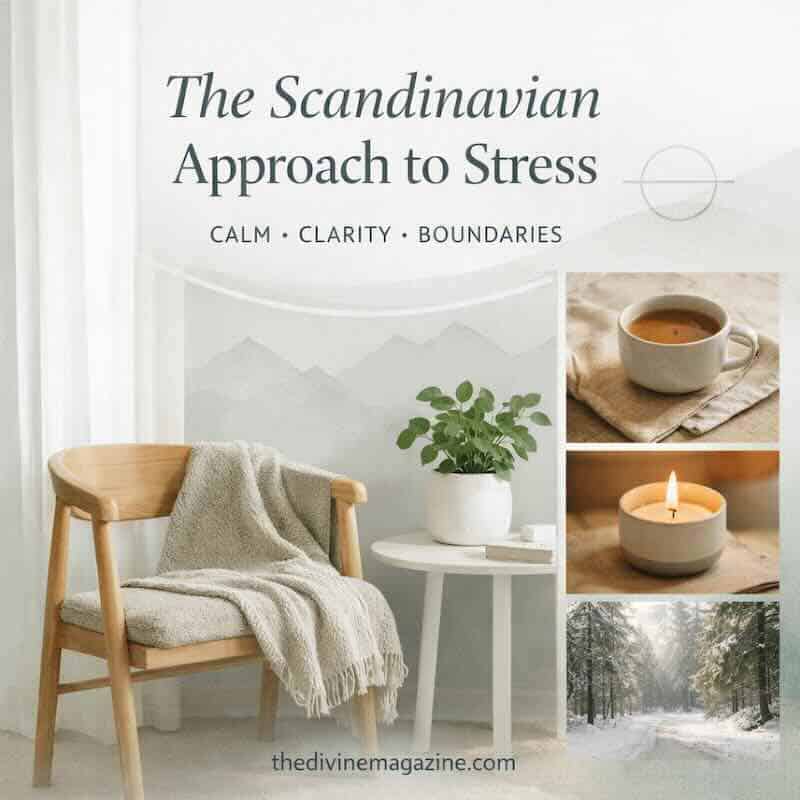
The Scandinavian approach to stress is rooted in something quieter than productivity hacks or hustle culture. It’s about designing a life where calm, clarity, and boundaries are built into everyday choices — from how you work and rest to how you relate to others and your environment. Rather than pushing through stress at all costs, Scandinavian cultures tend to normalize balance, recovery, and “lagom” — not too much, not too little.
- Core Principles of the Scandinavian Approach to Stress
- Calm: Creating Everyday Micro-Moments of Ease
- Clarity: Knowing Your Limits and Priorities
- Boundaries: Protecting Time, Energy, and Attention
- Nature and Simplicity as Stress Buffers
- Bringing Scandinavian-Inspired Calm Into Your Own Life
- When Stress Becomes Overwhelming
- Conclusion: Calm, Clarity, and Boundaries as Everyday Practice
- FAQ: The Scandinavian Approach to Stress
This guide explores key principles behind the Scandinavian approach to stress and how you can adapt them in your own life, wherever you live. We’ll look at cultural concepts like lagom and hygge, the role of nature, and the importance of boundaries at work and at home.
While these ideas can be helpful, they are not a substitute for professional care. If you’re experiencing persistent or worsening symptoms of stress, anxiety, or burnout, it’s important to speak with a qualified healthcare professional or mental health provider.
Core Principles of the Scandinavian Approach to Stress
Scandinavian countries like Sweden, Norway, and Denmark consistently rank high in measures of wellbeing and life satisfaction. This doesn’t mean people there don’t experience stress — they do — but cultural norms often support healthier ways of relating to it. You can explore broader context in reports from the World Happiness Report and the OECD Better Life Index.
- Lagom (Sweden): The idea of “just enough” — not overextending, not under-engaging.
- Hygge (Denmark): Everyday coziness, warmth, and connection as a buffer against stress.
- Friluftsliv (Norway/Scandinavia): “Open-air life” — regular time in nature as a basic need, not a luxury.
- Boundaries: Clear lines between work and private life, and social acceptance of saying no.
Calm: Creating Everyday Micro-Moments of Ease
Calm in the Scandinavian sense is not about a perfect, stress-free life. It’s about intentionally building small, repeatable moments of ease into your day. This might look like a quiet coffee break, a short walk in fresh air, or a phone-free evening ritual.
Research suggests that brief, regular recovery periods can reduce the impact of stress on the body and mind. For more on stress and recovery, see resources from the American Psychological Association and the American Institute of Stress.

Clarity: Knowing Your Limits and Priorities
Clarity is central to the Scandinavian approach: knowing what matters, what doesn’t, and where your limits are. This often shows up in:
- Realistic expectations: Not glorifying overwork or constant availability.
- Transparent communication: Being honest about capacity, deadlines, and needs.
- Simple structures: Using routines and planning to reduce decision fatigue.
Clarity doesn’t remove stress, but it reduces unnecessary friction. When you know your priorities, it becomes easier to say no, delegate, or slow down without feeling like you’re failing.
Boundaries: Protecting Time, Energy, and Attention
Healthy boundaries are a defining feature of Scandinavian work and home life. There is a stronger cultural norm around leaving work on time, taking vacation days, and protecting evenings and weekends for rest, family, and personal interests.
Boundaries can include:
- Work hours: Setting clear start and end times, and limiting after-hours email.
- Social commitments: Saying no to plans when you need rest, without guilt.
- Digital boundaries: Limiting notifications and screen time, especially before bed.
If setting boundaries feels difficult, you might find it helpful to explore guidance from mental health organizations like Mind (UK) or the Mental Health Foundation.
Nature and Simplicity as Stress Buffers
Spending time outdoors is deeply woven into Scandinavian life. Even in colder months, people walk, hike, or simply sit outside with a warm drink. This regular contact with nature — friluftsliv — is associated with lower stress and improved mood.
Studies suggest that time in green spaces can reduce stress and support mental health. You can explore more through resources from the American Psychological Association on nature and wellbeing and the World Health Organization’s overview of urban green spaces.
Bringing Scandinavian-Inspired Calm Into Your Own Life
- Define “enough” for yourself: Decide what a “good enough” day or week looks like, instead of chasing perfection.
- Schedule recovery: Treat rest, walks, and quiet time as non-negotiable appointments.
- Simplify your environment: Reduce visual clutter and create one or two calm corners at home.
- Practice honest no’s: Start with small boundaries — one thing you decline or postpone each week.
- Use nature as a reset: Even short, regular walks or time by a window can help.
When Stress Becomes Overwhelming
Everyone experiences stress, but if it becomes constant, overwhelming, or starts to affect your sleep, appetite, relationships, or ability to function, it’s important to seek professional support. A doctor, psychologist, or licensed therapist can help you understand what you’re experiencing and discuss options such as therapy, lifestyle adjustments, or other treatments.
You can learn more about stress, anxiety, and related conditions from the World Health Organization and the National Institute of Mental Health. If you’re in immediate crisis or worried about your safety, contact local emergency services or crisis support in your area right away.
Conclusion: Calm, Clarity, and Boundaries as Everyday Practice
The Scandinavian approach to stress isn’t about being endlessly relaxed — it’s about designing a life where calm, clarity, and boundaries are part of the structure, not an afterthought. By defining what “enough” looks like, protecting your time and energy, and weaving in simple moments of nature and coziness, you can create more space to breathe, think, and recover.
You don’t have to live in Scandinavia to experiment with these ideas. Start small, stay curious about what actually helps you feel more grounded, and remember that adjusting your life to protect your wellbeing is not indulgent — it’s responsible.
FAQ: The Scandinavian Approach to Stress
1. Is the Scandinavian approach to stress realistic outside Scandinavia?
You may not have the same social systems, work policies, or environment, but you can still adapt core principles: clearer boundaries, simpler routines, and more intentional rest. Focus on what is within your control — even small changes can make a difference over time.
2. Does “lagom” mean lowering my ambitions?
No. “Lagom” is about balance, not mediocrity. It encourages sustainable effort instead of burnout. You can still be ambitious while respecting your limits and building in recovery, which often supports better long-term performance.
3. How can I start setting boundaries if I’m not used to it?
Begin with one small, specific boundary — for example, no work emails after a certain time, or one evening per week reserved for rest. Communicate it clearly and kindly. If it feels uncomfortable, that doesn’t mean it’s wrong; it may simply be new. If boundary-setting is very difficult or tied to deeper patterns, a therapist can help you explore this safely.
4. What if I don’t have easy access to nature?
Nature doesn’t have to mean forests or mountains. It can be a local park, a tree-lined street, a balcony with plants, or even a window with sky and light. Short, regular contact with any form of nature can still be beneficial. Look for small, repeatable ways to bring natural elements into your daily life.
5. Can these ideas replace therapy or medical treatment?
No. Scandinavian-inspired habits can support wellbeing, but they are not a replacement for professional care when stress, anxiety, or depression are significant or persistent. If you’re struggling, it’s important to speak with a qualified healthcare professional who can help you explore appropriate treatment options.
Adopting elements of the Scandinavian approach to stress is less about copying a lifestyle and more about asking: what would my days look like if calm, clarity, and boundaries were non-negotiable? Your answers to that question can guide meaningful, sustainable change.