
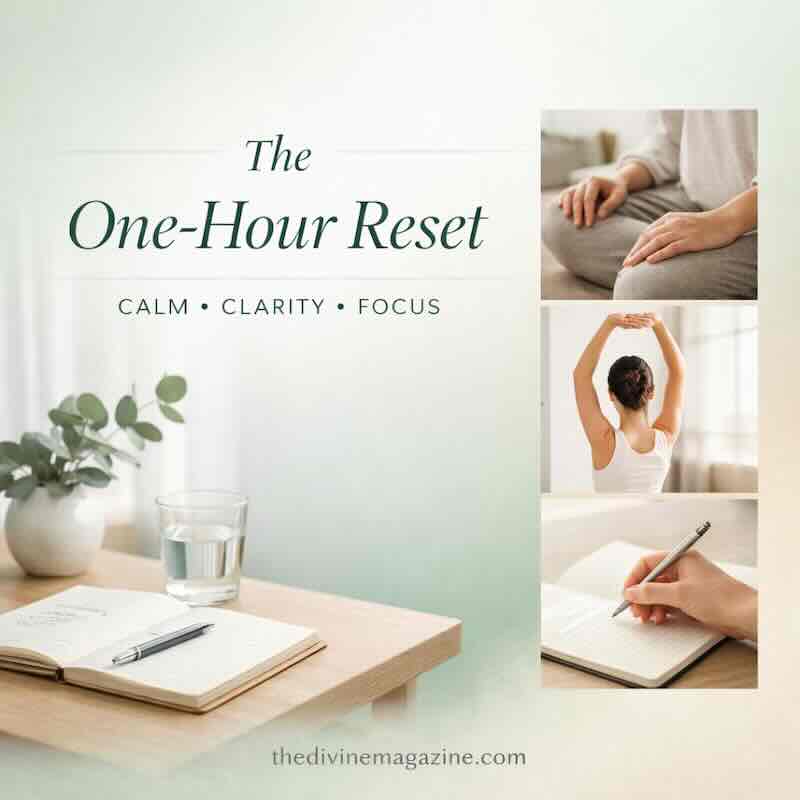
Some days feel like they’re running you instead of the other way around. Your inbox is overflowing, your brain is buzzing, and even simple decisions feel heavy. When you’re overwhelmed, you don’t always need a full life overhaul — sometimes you just need a structured, intentional one-hour reset to clear the mental clutter and start again with focus.
This simple, science-informed routine is designed for those days when you feel scattered, stressed, or stuck. In just 60 minutes, you’ll move your body, calm your nervous system, reset your environment, and choose your next steps with clarity. Think of it as a mini “system reboot” for your day. For more on why short resets work, you can explore resources like APA’s overview on stress and Mind’s everyday stress tips.
Why a One‑Hour Reset Works
When you’re overwhelmed, your brain tends to jump between tasks, worries, and unfinished to‑dos. A short, structured reset interrupts that spiral and gives your mind a clear sequence to follow. You’re not trying to “fix your whole life” — you’re simply giving yourself one hour of intentional care and direction.
Research suggests that short breaks and focused work blocks can improve concentration and reduce mental fatigue. Techniques like the Pomodoro Technique and movement breaks are widely used to restore focus. This routine borrows from those ideas but packages them into a single, gentle reset you can use anytime your day feels like too much.
The One‑Hour Reset: Step‑by‑Step
You can do this routine at home, in your office, or even in a quiet corner with headphones. Set a timer for each segment so you don’t have to think about the clock. The goal is not perfection — it’s progress and relief.
Minutes 0–5: Pause and Breathe
Start by stepping away from your screens. Sit or stand comfortably, close your eyes if it feels safe, and take slow, deep breaths. Try a simple 4–4–6 pattern: inhale for 4 seconds, hold for 4, exhale for 6. This helps signal to your nervous system that you’re safe and can slow down.

If you like guided support, you can use a short breathing exercise from apps or platforms like Headspace or Calm’s breathing tools.
Minutes 5–15: Gentle Movement
Overwhelm often lives in the body as much as in the mind. Spend 10 minutes moving gently: stretch, walk around the room, do a few yoga poses, or take a quick walk outside if you can. The goal is to get your blood flowing and release some of the physical tension that’s been building up.
If you want structure, try a short beginner routine from Yoga Journal’s stress relief sequences or a 10‑minute walk or stretch video on YouTube.
Minutes 15–25: Clear Your Space
Next, reset your environment. Spend 10 minutes tidying the space immediately around you: clear your desk, throw away trash, stack papers, close unnecessary tabs on your computer, refill your water. A calmer physical space often makes your mind feel less chaotic.
You don’t need a full deep clean — just focus on what’s visible and distracting. For simple decluttering ideas, you can explore Becoming Minimalist’s decluttering tips.
Minutes 25–40: Brain Dump and Sort
Now that your body and space are calmer, it’s time to clear your mind. Take a notebook or open a blank document and write down everything that’s swirling in your head: tasks, worries, reminders, ideas. Don’t organize yet — just get it all out.
After 5–7 minutes of writing, quickly sort what you’ve written into three simple categories:
- Do today – urgent or truly important tasks.
- Do later – things that matter but aren’t urgent.
- Let go – things you can delete, delegate, or stop worrying about.
This is a lightweight version of task management approaches like the Eisenhower Matrix, but simplified for overwhelmed days.
Minutes 40–55: One Focused Block
From your “Do today” list, choose one task that will make the rest of your day feel lighter if you complete it. Set a 15‑minute timer and work on that task only — no multitasking, no checking messages, no switching tabs unless it’s directly related.
Think of this as a mini focus sprint. Even if you don’t finish the task, you’ll have moved it forward, which often reduces anxiety. For more on focused work blocks, you can read about deep work principles on Notion’s deep work guide.
Minutes 55–60: Close and Intentionally Restart
Use the final 5 minutes to close the reset intentionally. Look at your “Do today” list and choose the next one or two steps you’ll take after this hour. Write them somewhere visible — a sticky note, your planner, or your task app.
Then, take one more slow breath, stretch your shoulders, and consciously decide: “I’m starting again from here.” This small mental line in the sand helps you separate the overwhelmed part of the day from the part you’re stepping into now.
Tips for Making the One‑Hour Reset a Habit
- Schedule it: Add a recurring “reset” block to your calendar on busy days.
- Keep tools ready: Have a notebook, pen, and water bottle nearby.
- Use headphones: If you’re in a shared space, use calming music or noise to create a mental boundary.
- Be flexible: On extremely packed days, try a 30‑minute version using shorter segments.
Over time, this routine can become a reliable fallback whenever your day feels like it’s slipping away from you. It’s not about doing everything — it’s about giving yourself a structured way to do something that genuinely helps.
Conclusion
Overwhelmed days don’t have to end in burnout or frustration. With a simple, repeatable one‑hour reset, you can interrupt the chaos, reconnect with your body, clear your mind, and choose your next steps with intention. You’re not fixing your entire life in 60 minutes — you’re giving yourself a compassionate, practical reset that makes the rest of the day more manageable.
The more you practice this routine, the easier it becomes to reach for it instead of doom‑scrolling, overworking, or shutting down. One hour can’t solve everything, but it can change the direction of your day.
FAQ: The One‑Hour Reset
1. What if I don’t have a full hour?
You can compress the reset into 20–30 minutes by shortening each segment. For example: 2 minutes of breathing, 5 minutes of movement, 5 minutes of brain dump, and 10–15 minutes of focused work. The structure matters more than the exact timing.
2. Can I use this routine every day?
Yes. Some people use it as a mid‑day reset, others as a way to recover from a rough morning or afternoon. If you notice you’re overwhelmed often, pairing this routine with longer‑term changes (like workload adjustments or boundaries) can be helpful. For boundary ideas, see Psychology Today’s guide to boundaries.
3. What if I feel guilty taking an hour “off”?
Feeling guilty is common, especially if you’re used to pushing through. But an hour spent resetting can make the rest of your work more effective and less draining. Think of it as maintenance, not avoidance — similar to charging a battery so it can actually function.
4. What if my mind won’t slow down during the breathing part?
That’s normal. You don’t need a perfectly quiet mind for the reset to work. Instead of fighting your thoughts, just keep gently returning your attention to your breath or to a guided audio. Over time, it usually gets easier. Short practices like those on Smiling Mind can help train this skill.
5. How do I know if I need a reset or a full break?
If you’re consistently exhausted, unmotivated, or struggling to function even after resets, you may need more than a one‑hour routine — like time off, workload changes, or professional support. This reset is a tool, not a cure‑all. If you’re concerned about chronic stress or burnout, consider speaking with a healthcare professional or counselor for more tailored guidance.