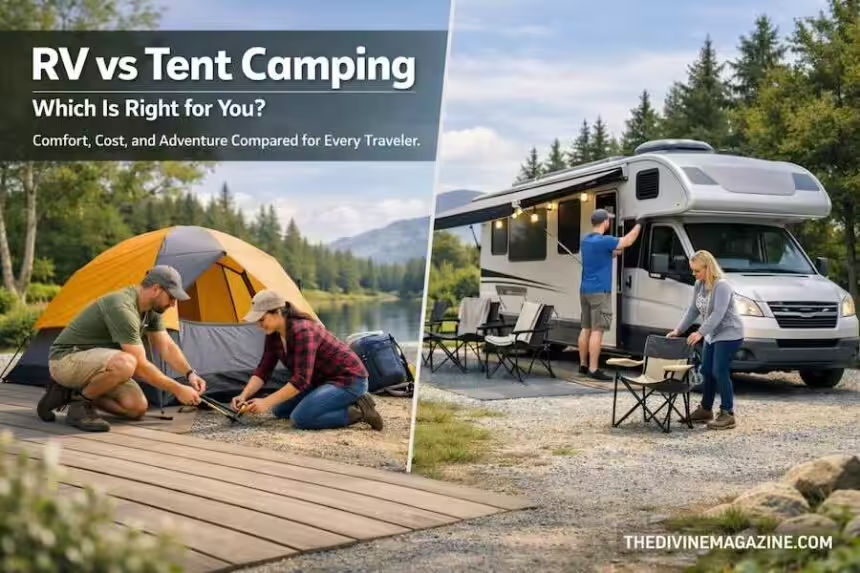
It’s really hard to find a camping enthusiast who isn’t passionate about this question. Needless to say, most of them adore either their tents or RVs and are only too happy to point out the benefits of their choices. However, the truth is that there is no universal answer to this question since people have vastly different expectations from their time in nature.
Just like a car that is perfect for one family is a bad choice for another, there are distinct pros and cons to both camping in a tent and traveling in an RV. If you’re still considering the best type of camping for your lifestyle, we suggest you take a look at the following operational elements before splashing out your hard-earned cash.
How Easy Is It to Set Up?
Modern tents and RVs are engineered to be quite user-friendly. Even if you’ve never spent a night in the wilderness before, you shouldn’t encounter too many roadblocks regardless of which route you choose. In most cases, standard modern ground tents can be fully pitched by one or two people in about 15 minutes. While expansive multi-room family tents naturally demand a bit more structural assembly and an extra pair of hands, it rarely takes more than half an hour to get your shelter secure. On the flip side, RV setup times vary drastically depending on the specific class of your rig.
A compact towable trailer requires unhitching, leveling, and deploying mechanical stabilizer jacks, whereas a agile Class B camper van or motorhome requires almost zero physical effort once parked. Massive luxury motorhomes will logically consume more of your arrival window because you’ll need to manage automatic slide-outs, heavy-duty exterior awnings, and utility hookups. Finally, keep in mind that breaking down and packing away a muddy or wet tent at the end of a trip is generally much more labor-intensive than simply driving away in an RV.
What Level of Comfort Are You Looking For?
This is one metric that yields a clear, definitive winner: RVs provide a vastly superior level of physical comfort. Sleeping in a tent means you are inherently tethered to the terrain, resting either directly on the ground on thin sleeping pads or on compact camping cots. Tents lack built-in climate control, leaving only a microscopic layer or two of synthetic fabric between you and shifting weather patterns. Meal prep requires setting up a separate portable stove, charcoal grill, or open campfire, and midnight bathroom runs usually involve a dark trek to communal campground facilities.
Conversely, an RV functions as a literal rolling home, with even modest pop-up trailers outclassing a basic tent setup. Motorhomes come fully integrated with private kitchenettes, dedicated mattresses, and onboard bathrooms. High-tier rigs frequently feature a premium RV air conditioner, which makes peak summer adventures incredibly pleasant. Furthermore, when your vehicle is plugged into shore power, city water, and sewer connections at an established campground, you get to enjoy all the seamless luxuries of modern residential living out in the woods.

Which One Is More Secure?
Once again, RVs dominate when it comes to personal security and peace of mind. Most motorhomes feature heavy-duty deadbolts and locking entry doors similar to a traditional residential home. Tents, by contrast, rely on a simple fabric zipper that can be easily bypassed. When camping in habitats shared with curious wildlife or persistent insects, a hard-sided vehicle provides an impenetrable physical barrier. This structural security also makes it effortless to keep expensive gear, laptops, and cameras locked safely away whenever you head out on an all-day hike.
What About the Overall Costs?
This is the category where traditional tent camping has an unbeatable advantage. Not only is the initial retail purchase or rental price of high-quality tent gear a microscopic fraction of buying a motorized vehicle, but nightly campsite reservation fees are also significantly cheaper for tent pads. Over a lifetime of travel, you will spend exponentially less money maintaining a tent setup. Even if you purchase an elite, modern inflatable air-beam tent, your financial investment remains minor compared to the purchase price, insurance, storage fees, and fuel costs of a standard RV.
Which Option Allows More Freedom?
Tents emerge as the clear winner in this final category. There are thousands of pristine, remote backcountry sites across global public lands that are completely inaccessible to motorized vehicles. For an RV to access a site, you require a wide, well-maintained road devoid of low-hanging branches and tight switchbacks. Tent camping, however, gives you the freedom to park your vehicle at a distant trailhead, load your gear into a backpack, and hike deep into remote wilderness areas where tranquility is guaranteed.
Ultimately, your final decision hinges on the specific style of vacation you prefer and the size of the budget you are ready to allocate. If you are still on the fence, avoid investing thousands into gear right away. Instead, experiment by utilizing peer-to-peer rental networks to test out an RV for a quick weekend getaway, and then replicate the experiment using a basic tent setup. Letting your real-world experiences guide your wallet ensures you’ll choose the absolute perfect fit for your outdoor lifestyle.
Conclusion: Matching Your Camping Style to Your Intentions
Choosing between a tent and an RV isn’t about deciding which method is objectively superior; it’s about determining which platform aligns with your personal travel goals. If your ultimate priority is off-grid exploration, minimalist simplicity, and Budget-friendly access to remote terrain, a tent is an unmatched tool. If your goal is multi-week cross-country road trips, climate-controlled comfort, and a seamless routine for the whole family, an RV is well worth the investment. For deep dives into campground availability, park guidelines, and safe camping practices across public lands, resources like the National Park Service (NPS) offer invaluable, up-to-date regional mapping and safety regulations. Pick your platform, plan your route, and embrace the open road.
Frequently Asked Questions
Q: What is “boondocking” or “dry camping” in an RV, and how does it compare to tent camping?
A: Boondocking—also known as dry camping—refers to camping in an RV without any shared hookups for electricity, water, or sewer. It typically takes place on free public lands, such as Bureau of Land Management (BLM) areas. In this setup, an RV operates much like a tent because you must rely strictly on onboard battery power, stored fresh water, and holding tanks, though you still retain the comfort of hard-sided walls and real mattresses.
Q: Do I need a special commercial driver’s license (CDL) to drive a large RV?
A: In the vast majority of cases, no. Regular Class B and Class C motorhomes, as well as standard travel trailers, can be legally operated with a standard, non-commercial driver’s license. However, laws can vary slightly depending on your specific state or country if a vehicle’s Gross Vehicle Weight Rating (GVWR) exceeds 26,000 pounds. It is always best to double-check local transit rules before renting a massive rig.
Q: Can I park an RV anywhere tent camping is allowed?
A: Absolutely not. Many established campgrounds feature dedicated tent-only loops designed specifically to eliminate vehicle noise, exhaust, and generators from the area. Furthermore, many backcountry sites require hiking in on foot, making them physically impossible to access by vehicle. Always review campground maps closely to ensure your selected site explicitly accommodates the total length of your rig.
Q: How do I safely store food to prevent attracting bears when tent camping?
A: When camping in bear country, never store food, scented toiletries, or trash inside your tent. If you are car-camping, keep these items sealed inside a locked vehicle with the windows rolled completely up. If you are in a remote backcountry setting, utilize a certified bear-resistant food canister or hang your food bag at least 10 feet high and 4 feet out from a sturdy tree branch to keep wildlife safe and distant.